
For years, we have built Trenara around a single principle. The runner comes first. That is why we have chosen a new step no other running app has taken. As a Peak Pro user, you can now enter your own thresholds in your profile. These two values form the basis of your zones and training load. No algorithmic estimation but a reflection of your individual metabolic reality. It is a shift from data first to physiology first.
The change looks small. Two new fields in the app. In reality, they reshape your entire plan. From now on, your training follows you. Anyone who has ever done a lab test or pays attention to signals like breathing, heart rate and recovery knows how valuable this feature is. Let us dive deeper into why this matters.
What Do LT1 and LT2 Mean for Running Performance?
In an earlier blog coach Christophe explained that you do not have one single fitness level, but two.
Every running app and every algorithm can estimate your second lactate threshold reasonably well. We usually derive it from a race performance, often a 10K. That already gives us useful information about where your point of acidosis lies. LT1, reflecting your base fitness, then becomes a derivative of LT2. It is not calculated as its own value, but always approximated from LT2.
Physiologically, that is incorrect. LT1 plays a key role in endurance performance because it is linked to mitochondrial biogenesis and capillarisation.
At a population level and over long periods of time, algorithmic estimates are often good enough to work with. At an individual level and within a certain timeframe they may not be. You often feel this yourself: "This pace is too fast for an easy run." or "This pace is too slow for a threshold session.". No app can measure your thresholds. We calculate them, and that calculation is often good enough. But, it may not reflect your own reality. You do not always need a lab test to notice this. Sometimes your body shows you where the thresholds are.
Earlier this year, we made major changes to how we define training zones and plans. This raised the overall quality of the training plans. As a coach, I want to raise the bar further. We are an app built by runners for runners. The better our architecture, the better the result. From data driven to data informed.
This is a step in that direction. From now on, your 5K or 10K performance no longer defines your thresholds. We follow the correct path. Your thresholds define your performance.
Important note. Thresholds have no influence on our race predictions. In the training plans, workouts that target performance remain linked to those predictions.
What Trenara Does Differently With Your Thresholds
Data is important in an app. And to make things simple, we often adapt to that data. For those who know the principle: function follows form. In Trenara, the runner comes first. This update makes that clear. We adapt to you.
Running apps generate training plans based on relatively little personal information. We do this well, if I may say so. Now that you can set your thresholds in Trenara, we have shifted the playing field. No other app gives you this much influence on your training plan. That is because most plans are automatic products of data generation rather than physiology or coaching logic.
We have flipped that logic.
To people who are not runners, these two new fields on your profile page may look like a detail. To you, they are a major step forward. And it does not stop there.
A Concrete Example: Runner A vs Runner B
Let us use a fictitious but clear example. Imagine two Trenara runners who both run a 10K in 45 minutes. Based on that performance, an algorithm might estimate their LT2 at around 4:38 per km and LT1 at 5:10 per km, as a derivative of LT2. In reality, the two runners could look totally different:
Runner | LT1 | LT2 | Profile |
|---|---|---|---|
A | 5:10/km | 4:37/km | typical profile, thresholds are aligned |
B | 5:30/km | 4:36/km | strong at high intensity, weak aerobic base |
Runner A fits perfectly within the model. Runner B does not. His LT2 is correct, but his LT1 is 20 seconds slower than the estimate.
What does this mean in practice? Runner B would do his easy runs too fast. That leads to fatigue, poorer recovery and possible stagnation. His zones are based on a threshold he does not have.
By entering his real LT1, whether measured in a test or through observation, his plan becomes much more accurate, personal and effective. This is exactly why we introduce this feature.
Testing and Science: How We Integrate LT1 and LT2
It is no coincidence that this update is happening now. Since early 2025, a doctoral researcher from KU Leuven has joined our payroll through a Baekeland mandate. Part of her PhD project is bringing threshold calculations as close as possible to the gold standard: the laboratory test. It shows our drive in terms of sports science.
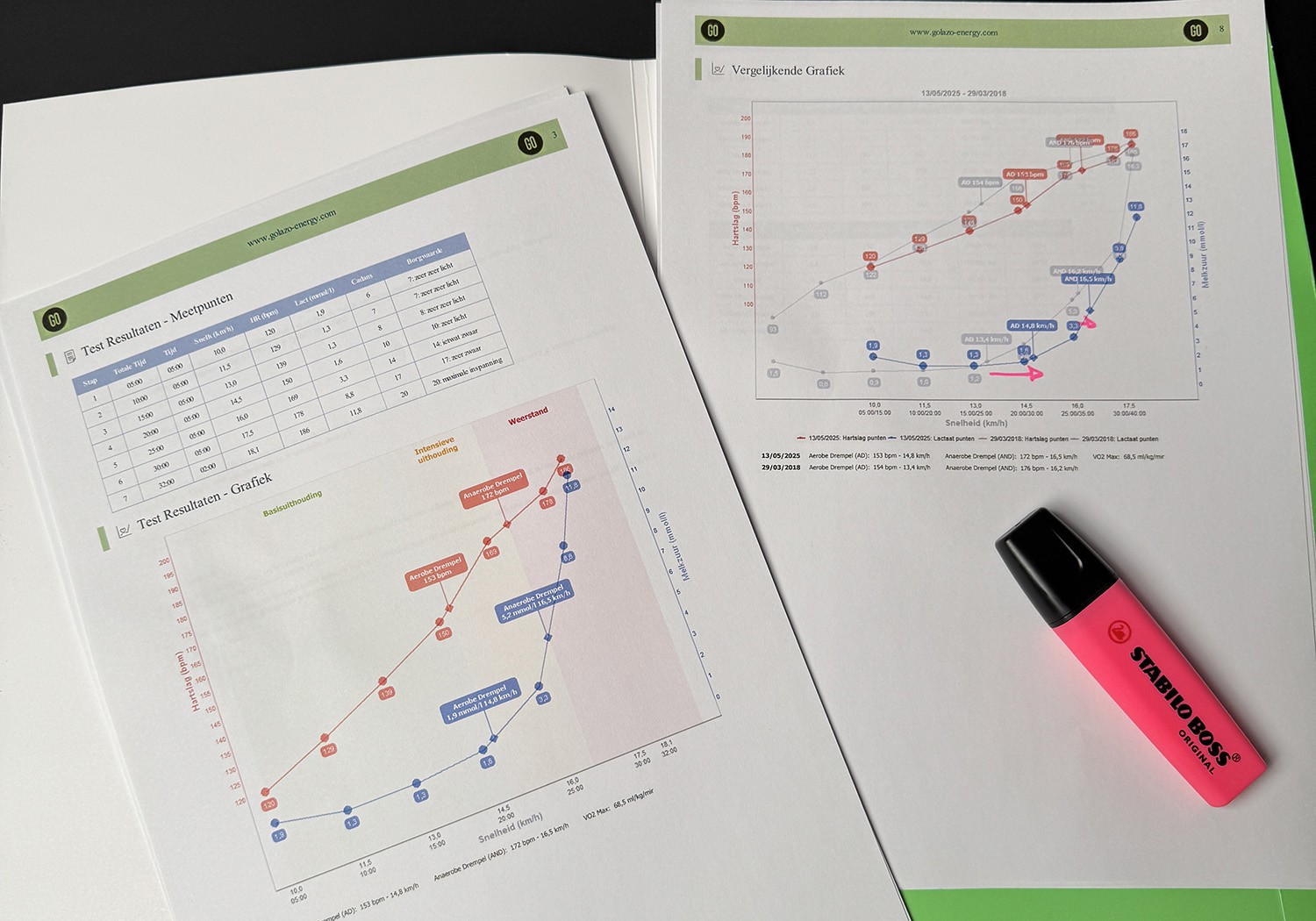
To eventually implement her findings in the app, we had to evolve from data to physiology first. That step has now been taken. Many of you already completed a performance test through Peak Pro Perks at Golazo Energy. You can now enter those results directly into Trenara.
This update will become a source of new information. We can compare our estimates with real thresholds. That may improve our calculations over time. It will likely also impact your training mix in the future. When we see that certain physiological aspects are underdeveloped, we can tailor the plan accordingly.
Trenara becomes even more personal. With this step, you no longer train based on a performance model. You train based on your physiology. That is where real progress begins.